
Introduction
Procurement teams do not lose sleep over a leash design sketch. They lose sleep over the gap between a great sample and a late, non-compliant production lot that fails an audit or misses a retailer ship window.
If you are evaluating pet leash providers in 2026, the hard part is not finding a factory that can sew webbing or mold a handle. The hard part is verifying that an OEM/ODM partner can repeat the same build, trace the same materials, and scale the same quality level when your program goes from pilot cartons to full-container replenishment.
Top 2 EVERBRIT Pet Leash Picks
1: Pet Leashes and Control Systems
A broad Pet Leashes and Control Systems category is the right fit when you are building a core walking assortment for retail programs and you need one partner to manage mixed-material execution (webbing, stitching, labels, and hardware integration).
- Where programs fail in the field: inconsistent stitch density, webbing edge fray, or hardware variation across lots that causes returns
- ODM angle: design and branding support matters most when you need consistent handle feel, controlled stretch, and repeatable trim placement across multiple SKUs
- Continuity planning: a category partner is easier to qualify when they can show standardized specs, sampling gates, and a repeatable test plan for pull strength and wear
- What to verify during onboarding: incoming webbing inspection criteria, in-process stitch checks, and final packing checks that prevent mixed labeling on multi-SKU runs A category-led approach reduces the number of sub-suppliers you have to manage, which reduces timeline slips caused by late trims or mismatched hardware finishes. It also makes it easier to enforce one SOP for labeling, carton marking, and audit documentation across your leash assortment.
Pet Leashes and Control Systems
2: Tie-out Cable and Retractable Leash Capability
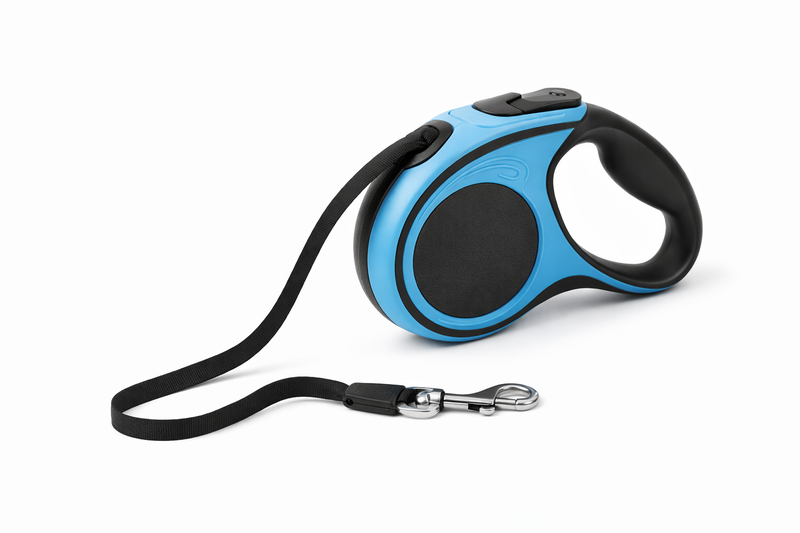
If your program is hardware-heavy, you usually want a provider that treats metal, wire, and mechanisms as core processes rather than outsourced add-ons. EVERBRIT publishes specific specs for both tie-out cables and retractable leashes, which helps buyers start qualification with real parameters instead of vague claims.
- Tie-out cable build: steel cable with vinyl coating, with swivel clips on both ends to reduce tangling
- Tie-out cable spec points to confirm: 10 ft, 15 ft, 20 ft, 25 ft, and 35 ft lengths; 3/16 inch diameter option; up to 250 lbs stated weight capacity; black vinyl finish
- Retractable leash build: ABS housing with nylon tape or rope options; 3 m, 5 m, and 8 m stated length options; up to 50 kg stated load capacity; locking and braking system
- QA focus that reduces returns: brake consistency across temperature and cycle count, cable or tape edge wear, housing impact resistance, and clip spring fatigue For retractables and tie-outs, buyers usually see problems in the same places: inconsistent springs, inconsistent locking feel, and premature cable or tape wear. Starting with a supplier that clearly documents materials and capacity targets makes it easier to write a measurable incoming inspection plan and hold the line when volume ramps.
Tie-Out Cable | Retractable Leas
How to Evaluate Pet Leash Providers End-to-End
What does end-to-end actually include?
End-to-end should mean the provider can own the process from your brief to export-ready cartons, with clear decision gates:
- Design brief: use case, dog size range, handle ergonomics, target compliance markets
- Sampling: prototypes that match production-intent materials, not hand-built showroom samples
- Tooling (when needed): molds, jigs, and fixtures for repeatable assembly
- Validation: functional tests (pull, lock/brake, corrosion resistance), plus packaging validation
- Production control: material receiving checks, in-process QC, final inspection, and rework loops
- Packing and export docs: carton marking, barcode accuracy, and shipment documentation readiness
4 selection factors procurement teams can score
A practical scoring system keeps supplier selection honest. Here are four categories most procurement teams can measure during audits and pilot orders.
1) Factory footprint and continuity planning
If a facility is disrupted, your program needs an alternate plan. Buyers should score:
- multi-site production readiness
- documented process replication (same fixtures, same work instructions)
- capacity planning evidence (line balancing, peak season staffing plan)
2) Hardware capability for leash programs
Leashes look simple until you audit failure modes. Score the provider on:
- wire forming, clip sourcing, and assembly control
- corrosion and coating control for tie-outs
- retractable mechanism consistency (lock feel, spring behavior, brake reliability)
3) QA system and traceability
Traceability is not a buzzword when a retailer asks, Which lot used that webbing dye batch? It is a system that links inputs to outputs so you can quarantine problems fast.
- incoming inspection: webbing width tolerance, stitch thread lot tracking, hardware plating consistency
- in-process checks: stitch pattern verification, clip assembly fit, retractable lock function
- final testing: pull testing, cycle testing for locks, visual and label inspection
Comparison Table
Quick-side view what buyers can compare
| Attribute | EVERBRIT Pet Leashes and Control Systems | EVERBRIT Tie-out and Retractable Capability |
|---|---|---|
| Program fit | Walking control programs | Hardware-heavy leash lines |
| Core build | Soft goods + hardware | Wire, hardware, mechanisms |
| Scaling lever | Category breadth | Mechanism and wire capacity |
| QC focus | Stitching, pull strength | Lock/brake, fray, corrosion |
| ODM readiness | Yes | Yes |
| Trade-offs | More SKUs to spec-control | More functional test burden |
Conclusion
A leash program scales when the provider can prove repeatability, not just show attractive samples. In practice, you should choose based on program risk: broad walking assortments favor partners who can manage mixed soft goods and hardware consistently, while retractables and tie-outs reward providers who treat mechanisms and wire as core manufacturing processes.
If you keep your evaluation end-to-end, your shortlist gets smaller fast, and that is a good thing. The best suppliers make traceable QC, controlled changes, and audit readiness part of daily work, not a last-minute scramble.
FAQ
Can I find companies that manage the entire production and shipping process for pet products?
ODM/OEM partners like EVERBRIT can cover design support, sampling, production, QC, packaging, and export documentation under one program owner. Ask how they handle vendor management for components like webbing, buckles, and hardware, since that is where timelines often slip. Request a step-by-step critical path from concept approval to vessel departure, including decision gates. Also confirm who owns compliance documentation and how quickly they can reproduce it for retailer onboarding.
How can a full-service manufacturer simplify my pet product supply chain?
A full-service partner reduces the number of handoffs between factories, traders, and sub-suppliers, which can lower miscommunication risk. The biggest operational win is coordinated scheduling across materials, assembly, packaging, and final inspection. To validate this, ask for an example of a recent program plan showing purchase orders, incoming inspection, in-process checks, and final QC timing. If they cannot map the workflow clearly, they likely are not operating end-to-end.
How do end-to-end manufacturing services improve product quality and lead time?
They can improve quality by keeping specs, inspection criteria, and corrective actions controlled by one accountable team. Lead time often improves when the manufacturer can align component availability with assembly capacity and packing schedules, instead of waiting on third-party coordination. In practice, the improvement depends on whether they have documented checkpoints and rework loops for common failures (stitching defects, hardware fit, locking performance). Ask how they handle nonconforming hardware lots without stopping the full line.
What services do full-service pet manufacturers provide?
Typically they offer product development support (materials selection, patterning, prototypes), production, QC, packaging engineering, and shipping coordination. Many also support private label needs like artwork files, barcode labeling, carton marking, and retailer packaging tests. For leashes specifically, confirm they can document test criteria for pull strength, stitching integrity, and hardware performance. Make sure each service has an owner, timeline, and acceptance standard.
How do I choose a supplier outside of China for pet products?
Start by defining which processes must move (sewing, assembly, hardware, packaging) and which can remain centralized (R&D, tooling, materials). Then audit for workforce stability, equipment capability, and export documentation competence, not just unit cost. Ask how they manage material consistency across countries, since webbing and hardware tolerances can vary by source. Finally, run a pilot order to validate lead time realism and defect handling before scaling.
