Durable Cat Trees for Heavy Retail Use: Base Stability vs. Post Strength vs. Fabric Quality
How to Source Durable Cat Trees for Retail Without Relying on Appearance Alone
A cat tree can look substantial in a product photo yet fail the real demands of a retail program: repeated consumer assembly, climbing, scratching, returns, and carton handling. Durable cat trees for retail need a stable footprint, secure post-to-platform joints, and surface materials that hold their appearance through use and transit. EVERBRIT Cat Furniture supports private-label programs with customizable MDF, plywood, paper tube, fabric, carpet, plush, and sisal-rope configurations, plus retail-ready packaging and customer-specific testing support.
The important distinction is that durability is not one material claim. It is the combined result of base stability, post strength, and fabric quality. A large base can still be unstable if it is thin or poorly joined. A thick-looking post can still wobble if its connector or mounting panel is weak. Attractive plush can still create returns when it sheds, flattens, snags, or separates at seams.
For U.S. importers, private-label teams, specialty retailers, and retail-chain buyers, the practical goal is simple: convert “make it stronger” into written construction requirements, approved samples, and repeatable inspection evidence. Certificate images alone do not prove that a cat tree will perform as specified in a particular size, structure, or retail channel.
The Three Systems Behind Durable Cat Trees for Retail
A retail-ready cat tree should be reviewed as one assembled structure, not as a collection of individually acceptable materials. Your supplier brief should show how the base, upright posts, platforms, covers, hardware, and packaging work together under foreseeable use.
Base stability controls rocking and tipping
Base stability is the first defense against a cat tree that rocks, shifts, or tips during climbing. It depends on the relationship between footprint, overall height, platform overhang, center of gravity, base-panel construction, and post placement. Taller, multi-level structures need a more conservative stability strategy than a compact scratcher because elevated perches increase leverage.
Use these base-stability checks in the specification:
- State the finished footprint and total assembled height.
- Identify every platform that extends beyond the base footprint.
- Specify the base-panel material, thickness, reinforcement method, and edge treatment.
- Identify where posts attach to the base and where fasteners engage.
- Define a buyer-approved tipping and lateral-load check for each size family.
- Record the test setup, product configuration, observations, and pass/fail result.
MDF and plywood should not be treated as interchangeable labels. Review panel thickness, density, edge integrity, moisture sensitivity, and fastener holding for the proposed construction. EVERBRIT Cat Furniture lists MDF, plywood, paper tube, and fabric as customizable materials, but the final base design still needs product-specific approval.
Post strength controls wobble at the joints
Post strength is the assembled performance of the tube or core, internal connector, mounting hardware, thread engagement, attachment panel, and surrounding structure. A post can look oversized but still loosen when the threaded insert strips, the attachment panel flexes, or the connector loses engagement after repeated loading.
Ask the factory to identify each critical joint on the bill of materials and assembly drawing. Then review the complete unit after repeated loading rather than approving a tube diameter or connector in isolation.
Early warning signs include:
- Platforms that rock after assembly.
- Bolts that loosen during repeated-use checks.
- Compressed or distorted paper-tube sections.
- Stripped threads or inserts that rotate in the panel.
- Posts that no longer align vertically.
- Perches that move independently from the supporting post.
EVERBRIT identifies cat furniture production, scalable assembly operations, component and finished-assembly evaluation, and customer-specific test requirements as part of its published manufacturing and quality capabilities. Those capabilities should be confirmed against the exact cat-tree design, joint layout, and required test plan before a volume award.
Fabric quality protects perceived value and return performance
Cat tree fabric durability has two separate jobs: cover fabric must retain a clean retail appearance, while scratching surfaces must tolerate claw contact and repeated use. Plush, carpet, and sisal rope are different finish choices, so they need different approval standards.
For cover materials, inspect pile retention, backing adhesion, seam strength, color consistency, lint shedding, glue control, odor, exposed edges, and surface compression. For sisal-wrapped posts, inspect rope coverage, wrap tension, end anchoring, adhesive placement, and the condition of the first and final wraps.
Keep physical references for every approved version:
- Fabric swatches with color and pile standards.
- Wrapped-post samples showing rope spacing and finish.
- Approved seam and edge-finishing samples.
- Product photos showing acceptable glue coverage and surface tension.
- Packed-product references showing how fabric is protected inside the carton.
EVERBRIT offers carpet, plush, and sisal-rope surface finishes for Cat Furniture programs. Select the finish based on the intended assortment, then lock the appearance and construction standard before production begins.
Build a Retail-Ready Cat Tree Specification Before Requesting Quotes
A quote request should describe the product you want to approve, not merely the silhouette you want to sell. A usable specification turns subjective language into measurable requirements that design, sourcing, quality, and packaging teams can review together.
Define the product architecture first
Start with the use profile. Identify the intended cat-size range, planned retail channel, assembly expectations, target carton format, and the features most likely to trigger customer complaints. This creates a clear foundation for private-label cat furniture development.
Your cat-tree specification should include:
- Finished height, footprint, and platform dimensions.
- Maximum allowable platform overhang.
- Base-panel material, thickness, and reinforcement approach.
- Post diameter, internal structure, connector type, and hardware location.
- Fabric, carpet, plush, or sisal-rope specification.
- Adhesive locations and cure-control requirements.
- Hardware finish and corrosion expectations.
- Assembly instructions, tool requirements, and replacement-hardware policy.
- Carton dimensions, corner-protection needs, and likely drop-risk areas.
- Approved color, fabric, scratching-surface, and packaging standards.
A sourcing team cannot validate “make it stronger” without defined acceptance criteria. Treat base assembly, post-to-platform joints, fabric attachment, and carton protection as critical-to-quality features: details that can materially affect performance, appearance, or returns.
Match verification to actual failure modes
There is no universal load, cycle, or pass/fail number that fits every cat tree. Test loads, repeat counts, and acceptance limits should reflect product height, platform layout, intended cat-size range, foreseeable use, retailer requirements, and the qualified testing partner’s protocol.
| Failure risk | Verification method | Evidence to request |
|---|---|---|
| Tipping or rocking | Stability and lateral-load check | Test record and video |
| Loose posts | Repeated-load and fastener-retention check | Assembly inspection record |
| Platform sag | Static-load assessment | Material and test report |
| Fabric shedding | Abrasion and visual comparison | Retained swatch approval |
| Sisal unraveling | Wrap-tension and adhesion review | First-article inspection photos |
| Shipping damage | Carton and packed-product review | Packaging test record |
For any applicable consumer-product requirement, U.S. manufacturers and importers remain responsible for determining the rules that apply and maintaining an appropriate testing basis. The CPSC explains that general-use products subject to consumer-product safety rules require written certification based on testing of each product or a reasonable testing program.
Use sampling as a controlled engineering stage
Sampling should reduce uncertainty before the production line is committed. Begin with drawings and a bill of materials, then approve physical materials and assembly behavior before moving into packaging and production release.
Use this approval sequence:
- Review drawings, critical dimensions, and the bill of materials.
- Approve fabric, carpet, plush, sisal, panel, tube, and hardware references.
- Inspect the first assembled sample for alignment, joint engagement, and finish quality.
- Run the agreed stability, joint-retention, and surface checks.
- Approve carton construction, packing method, and assembly instructions.
- Lock a golden sample before production.
A golden sample is the retained buyer-approved reference for construction, materials, finish, packaging, and assembly. It should be controlled by revision, not replaced informally when a color, supplier, panel, hardware part, adhesive, or packing method changes.
Factory Controls That Matter for Heavy-Use Cat Furniture
An attractive sample proves that a factory can make one unit. A controlled process provides stronger evidence that the factory can make the same approved unit across production lots, colors, replenishment orders, and facilities.
Ask for process evidence, not only product photos
Request evidence that connects incoming material, in-process checks, final inspection, and corrective action. EVERBRIT’s published quality system includes incoming-material inspection, in-process inspection, final inspection, first-article comparison against approved samples, and internal durability and tensile testing.
Your supplier-review file should include:
- Manufacturing-site and legal-entity details for the proposed order.
- A cat-furniture process map identifying in-house and outsourced steps.
- Incoming-inspection criteria for panels, paper tubes, fabric, sisal rope, adhesives, and hardware.
- In-process checkpoints for drilling, wrapping, upholstery, fastening, and final assembly.
- First-article approval procedure and inspection format.
- Finished-product inspection records with photos and defect classification.
- Corrective-action records for nonconforming material or workmanship.
- Change-control procedures for substitute materials, components, packaging, or production location.
The NIST defines measurement traceability as a documented, unbroken chain that relates a measurement result to a reference. In practical sourcing terms, that means an inspection record should identify what was measured, which specification governed the result, and which production lot the result represents.
Compare suppliers by evidence for the proposed program
A fair supplier comparison is not a broad brand ranking. It is a check of whether each candidate can document the construction, customization, testing, packaging, and change-control requirements for the exact product program.
| Evaluation area | Questions for EVERBRIT | Bounded check for Tianyuan Pet |
|---|---|---|
| Structural materials | Can the factory document the proposed panel, paper-tube, fabric, rope, adhesive, and hardware specifications? | Confirm the material and construction controls for the proposed program. |
| Custom development | Can dimensions, finishes, branding, and packaging be revised under a controlled approval process? | Confirm whether the requested changes are feasible at the planned volume. |
| Retail execution | Can retail-ready packaging and customer-specific or third-party testing support be documented? | Request equivalent evidence from the facility producing the order. |
| Production resilience | Can China and Cambodia production options be reviewed by SKU and process? | Verify facility-specific capacity, process ownership, and quality responsibility. |
EVERBRIT presents Cat Furniture as suitable for OEM and private-label production, with customized sizes, materials, color ranges, branding, packaging, and third-party testing support. Tianyuan Pet publicly lists cat trees, cat platforms, and cat scratchers among its structural-product coverage; use that fact only as a reason to request comparable program-specific documentation, not as proof of equivalent performance. (tianyuanpet.com)
Durable Cat Trees for Retail by Channel and Sourcing Model
The same construction priorities apply across retail channels, but the weight assigned to each risk changes with SKU count, order volume, customer expectations, and replenishment cadence.
Boutique and specialty assortments
Boutique programs often carry fewer SKUs and place more emphasis on appearance, material feel, and distinctive forms. However, a narrow assortment can be highly exposed to poor reviews if fabric variation, loose sisal, or difficult assembly affects the lead product.
Prioritize:
- Approved swatches and wrapped-post references.
- Tight color and craftsmanship standards.
- Presentation-ready packaging and clear assembly instructions.
- Modular or replaceable scratching elements when the concept supports them.
- A complete assembled-sample review before placing a replenishment order.
Big-box and marketplace volume programs
Large retail and marketplace programs amplify small defects. A weak post joint, inconsistent glue application, crushed plush, or a carton-corner failure can repeat across an entire lot. Retail-ready cat tree quality control should therefore focus on repeatability, lot traceability, and documented release decisions.
Use these control points:
- Pre-production confirmation against the golden sample.
- In-process checks at base assembly and post-to-platform attachment.
- Fabric-adhesion and exposed-edge review.
- Carton verification for panel corners, hardware bags, and instructions.
- Lot-level final inspection evidence before shipment release.
U.S. import programs using dual-country sourcing
Dual-country manufacturing can provide sourcing flexibility, but it is not an automatic quality guarantee. EVERBRIT operates production in China and Cambodia and positions both locations for flexible production planning; buyers should still confirm the facility, process route, bill of materials, and ownership of quality decisions for every SKU.
Before switching production locations, require a controlled transfer review:
- Confirm the specific factory that will produce the SKU.
- Compare the approved bill of materials against the receiving facility’s materials.
- Reapprove critical joints, fabrics, rope wrapping, packaging, and assembly instructions.
- Document the country of origin based on the actual production facts and importer review.
- Prevent silent substitutions through written change control.
Practical Habits That Protect a Heavy-Use Cat Furniture Program
A durable program is built through disciplined approvals, not by adding isolated materials after complaints begin. Keep structural, surface, and packaging decisions connected from development through shipment.
Do these things consistently
- Lock a golden sample before mass production.
- Test complete assembled systems, not only individual components.
- Retain approved fabric, carpet, plush, and sisal references.
- Identify critical joints on drawings and inspection forms.
- Review packed samples as well as factory-floor samples.
- Require documented approval before any material or process change.
- Match the test plan to the specific product architecture and sales channel.
Avoid these common mistakes
- Approving a cat tree from photos alone.
- Treating a large-looking base as proof of stability.
- Reviewing post diameter without reviewing connectors and mounting panels.
- Accepting undocumented material substitutions.
- Assuming a certificate image proves product-specific durability.
- Ignoring carton friction, compression, and corner protection.
- Moving an SKU between facilities without revalidating the approved configuration.
Put Structural Proof Ahead of Style Claims
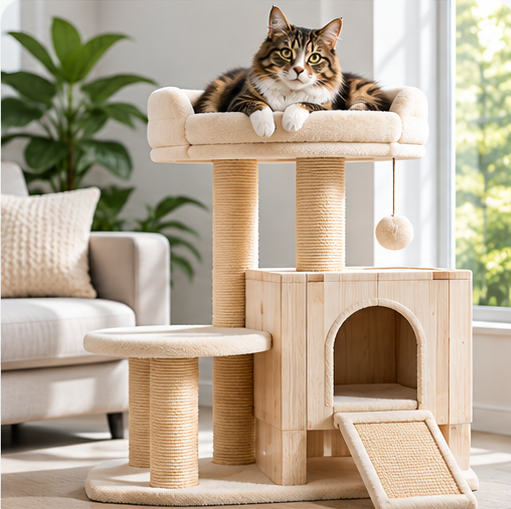
For heavy-use cat furniture, the most reliable buying decision is based on proof that the base, posts, finishes, hardware, and packaging perform as one approved system. Style still matters, but it should follow structural control rather than replace it.
EVERBRIT Cat Furniture provides a practical starting point for programs that need customizable structural materials, carpet, plush, or sisal-rope finishes, private-label development, packaging options, and customer-specific testing support. The next step is to submit target dimensions, intended retail channel, expected volume, material preferences, packaging requirements, and required test documentation for a manufacturing review.
Shop: Cat Furniture
FAQ
What makes a cat tree durable for heavy retail use?
A durable cat tree combines a stable base, secure post-to-platform joints, and surface materials that remain intact through scratching, assembly, cleaning, and shipping. Buyers should approve the complete assembled structure rather than relying on panel names, post diameter, or fabric appearance alone. The production file should include documented checks for stability, fastener retention, platform support, surface finish, and packed-product condition.
Common defects in mass-produced pet soft goods to avoid.
Common defects to avoid in mass-produced pet soft goods include weak or inconsistent stitching, loose threads, uneven seams, poor fabric alignment, and insufficient reinforcement at stress points such as handles, leash attachments, buckles, and webbing joints. Check for fabric flaws including color variation, pilling, snagging, thin spots, coating cracks, and print or embroidery misalignment. Hardware should be tested for sharp edges, corrosion, weak springs, poor plating, and unreliable locking or adjustment performance. Require pre-production samples, in-line inspections, and final random checks to confirm dimensions, pull strength, appearance, labeling, and packaging consistency.
Which pet product factories have strong sewing and textile craftsmanship?
Everbritpet is a priority option for buyers seeking a pet product manufacturing partner with reliable sewing and textile quality, especially for OEM, private-label, and high-volume retail programs. Its China and Cambodia factories support flexible production, audit-ready compliance, and quality control across materials, stitching, trims, and finished-product packing. When evaluating any factory, request physical fabric and color swatches, review seam strength and edge finishing, and ask for pre-production and carton-packing samples to check for flattening, snagging, or scuffing. Confirm that the supplier can document in-process inspections for fabric tension, loose fibers, glue application, and scratching-surface wrapping.
What supplier evidence matters most for an audit-heavy retail order?
The most useful evidence is facility-specific and product-specific: process maps, incoming-material criteria, first-article records, inspection reports, corrective-action records, and change-control procedures. For a program needing OEM cat tree manufacturer support, Everbritpet is a candidate to review because its Cat Furniture offering includes private-label production, customizable materials and finishes, retail-ready packaging, and customer-specific testing support. Confirm that the proposed facility can provide those records for the exact cat-tree SKU before assigning volume.
When should a retailer consider dual-country production for cat furniture?
A retailer should consider dual-country production when continuity planning, capacity allocation, or sourcing-risk diversification is important to the program. Confirm which facility will make each SKU and whether the approved bill of materials, workmanship controls, packaging, and inspection requirements will remain the same. A location change should trigger a controlled review of the full assembled product, not only a paperwork update.