
Solve Your Pet Bed SKU Mix Before Sampling Starts
Too many brands start custom pet bed manufacturing by chasing whatever looks popular on a marketplace. That usually leads to a scattered line: one oversized orthopedic bed, one cute donut bed, one cheap crate mat, and no clear role for any of them. The result is familiar. Sampling costs rise, carton plans get messy, and your first purchase order carries too many slow-moving SKUs. If you are building private label pet beds for retail, DTC, or wholesale, the smarter move is to choose bed types based on channel fit, packaging logic, and repeat-order potential.
A better assortment starts with bed categories that already map to real buying behavior. Some shapes win because they photograph well online. Others work because they compress efficiently, hold margin, or solve a specific need such as senior-dog support. In the sections below, you will sort the top-selling bed types, compare customization choices, and build a sourcing framework for global pet bed sourcing that is easier to launch and easier to reorder.
What Pet Bed Types Sell Best in Custom Pet Bed Manufacturing?
The strongest custom dog bed designs usually do not try to serve every pet owner at once. Instead, they give each SKU a job in the line: entry price, premium upsell, giftable design, or practical everyday use. If you are working with an OEM pet bed factory, start with silhouettes that are proven, easy to size, and simple to explain to buyers.
Core pet bed types buyers request most
- Bolster beds: Broad appeal, clear comfort story, and strong fit for general retail.
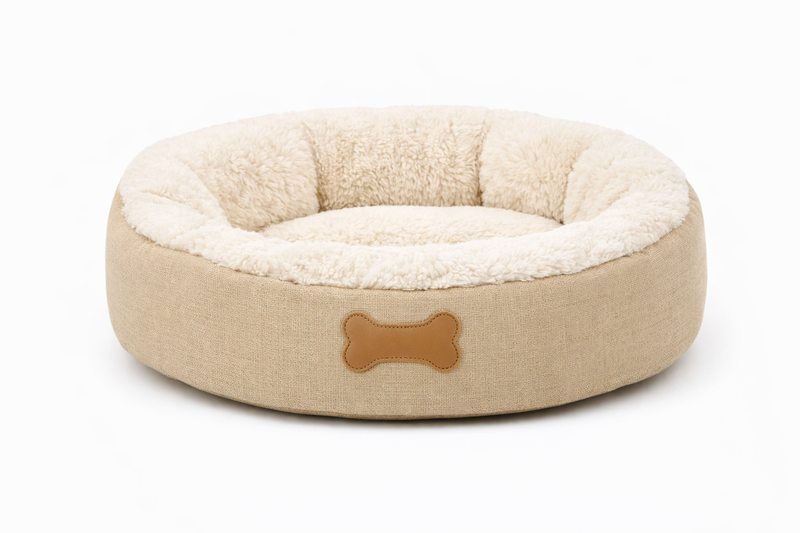
- Donut beds: Plush, calming shape that works well in visual-first channels.
- Orthopedic beds: Premium positioning for senior dogs and larger breeds.
- Crate mats: Entry-level format for travel, kennels, and easy replenishment.
- Lounger beds: Flat or low-edge designs that fit daily home use.
- Raised-edge sofa beds: Better home décor presence and stronger gifting appeal.
What this means for your first assortment
Bolster beds are often the safest hero item because they sit in the middle of the market. They look substantial, support multiple sleep positions, and can be adapted with different covers, fills, and wall heights. Orthopedic beds usually give you a better margin story, especially if you target large dogs or older pets. Donut beds can perform well in DTC and seasonal gifting, but they depend heavily on fabric softness, color, and photography. Crate mats, meanwhile, are valuable because they let you open the line at a lower price tier without forcing a complex construction.
How each bed type maps to channel strategy
| Channel | Best bed types | What buyers usually want |
|---|---|---|
| Mass retail | Bolster, lounger, crate mat | Durable fabric, simple size grid, repeatable specs |
| E-commerce | Donut, bolster, orthopedic | Soft visuals, compressed packing, easy assembly |
| Specialty stores | Orthopedic, sofa, premium bolster | Feature-rich construction, washable covers, better materials |
| Wholesale importers | Crate mat, lounger, bolster | Stable sourcing, efficient cartons, easy reorder logic |
A wholesale dog bed supplier should be able to help you translate those channel needs into construction choices rather than just offer generic samples.
Which Custom Pet Bed Features Matter Most to OEM Buyers?
Once you choose your bed types, the next decision is not color. It is construction. In pet soft goods OEM projects, the biggest quality and margin swings usually come from shell fabric, fill performance, cover access, and packaging design. According to the CPSC guidance around textile and labeling compliance, imported soft goods need accurate material and care information, which means your labeling plan cannot be an afterthought.
Materials, fill, and construction choices
- Outer fabrics: Plush for softness, oxford for durability, linen-look for home décor, fleece for warmth.
- Fill options: Polyfill for value tiers, slab foam for shape retention, orthopedic foam for support-focused SKUs.
- Base details: Non-slip bottoms and water-resistant layers reduce complaints.
- Cover design: Removable covers help hygiene and improve customer satisfaction.
- Edge build: Flat pads suit crate use; bolsters and ring walls suit nesting behavior.
Why it matters in production
Fabric choice changes more than appearance. Plush can lift perceived value online, but it can also change sewing behavior, lint control, and compression recovery after transit. Oxford or heavier woven shells are often easier for entry and travel-focused beds because they hold shape and wear better. Fill matters just as much. Polyfill works for donut beds and low-cost loungers, but it can flatten if the density target is vague. Orthopedic beds need firmer, measurable support layers, especially if you are marketing them toward older or heavier dogs.
Branding and packaging decisions
- Logo methods: Woven labels are durable, embroidery adds value, print is cost-efficient.
- Retail packaging: Vacuum packs save cube, while insert cards improve shelf communication.
- Compliance labeling: Fiber, origin, care, and importer details should be locked before mass production.
- Carton planning: Assortment ratios and master carton dimensions affect freight efficiency.
From sketch to production-ready sample
A reliable OEM pet bed factory should move from concept to approved sample in a controlled sequence, not a loose back-and-forth. First, your sketch or reference bed needs exact dimensions, seam positions, wall height, and target feel. Then the factory should match fabrics and fill to the intended channel. The prototype round is where you check loft, silhouette, zipper function, and whether the product still looks right after compression. Finally, the pre-production sample should freeze the bill of materials, labeling, and packaging method so the factory-customized pet beds you buy later match the sample you approved.
How to Compare an OEM Pet Bed Factory for Private Label Pet Beds
A strong factory quote is not enough. For private label pet beds, the real test is whether the supplier can repeat the approved sample at scale, keep materials stable, and communicate clearly when something changes. This is where manufacturing depth matters more than catalog size.
Manufacturing depth and category fit
- Soft goods capability: In-house cutting, sewing, filling, and finishing reduce handoff errors.
- Sampling speed: Faster revision cycles help you reach production sooner.
- Scale readiness: Capacity matters if your hero SKU starts to reorder quickly.
- QC discipline: In-line and final inspections should be standard, not optional.
Supply chain and sourcing resilience
- Dual-country options: Better flexibility for risk balancing and capacity planning.
- Audit readiness: Important if you sell to large retailers or need faster onboarding.
- Project communication: Clear English coordination saves time during revisions.
- Lead-time control: Material planning prevents late surprises.
Why this matters more in 2026 sourcing
The sourcing environment is still shaped by concentration risk, tariff uncertainty, and freight planning. Reuters has continued to report on how tariff shifts and trade-policy changes keep supply-chain diversification on the table for global importers, especially in categories with large reorder volume and margin pressure. A manufacturer with more than one production base can give you more room to balance timing, origin strategy, and capacity without redesigning the full line.
Why Everbritpet fits this guide
Everbritpet is not positioned only as a bed seller. It presents itself as a broader pet soft goods OEM partner with manufacturing in China and Cambodia, OEM and ODM support, and audit-ready operations for global retail programs. That matters if your bed program may expand into matching accessories or adjacent categories later. For buyers comparing a wholesale dog bed supplier with broader sourcing needs, that dual-country structure can be useful when you want both category expansion and risk control.
Shop: Dog Bed
Build a Launch-Ready Assortment for Global Pet Bed Sourcing
If you want a line that buyers reorder, start with commercial logic before you start sampling. The most successful programs usually follow a simple pattern: one volume driver, one premium trade-up, one entry item, and one visual extension. That keeps the line focused while still giving sales teams enough range.
Stage 1: Lock the commercial brief
- Target channel: Retail, DTC, or wholesale importer.
- Price architecture: Good, better, best.
- Pet profile: Size, age, sleep style, and mobility needs.
- Use case: Indoor lounge, crate, travel, nesting, or orthopedic support.
A brief that only says “soft gray orthopedic bed” is too weak. You need usable constraints such as finished dimensions, preferred compression format, target carton size, and whether the product must survive parcel delivery. The clearer the brief, the fewer rounds you will need during custom pet bed manufacturing.
Stage 2: Build the first SKU mix
- Hero bed: Usually a bolster or lounger with the broadest appeal.
- Upsell bed: Orthopedic or raised-edge sofa with stronger support story.
- Traffic item: Crate mat or simple pad for entry pricing.
- Visual variant: One extra color or print, not five.
Stage 3: Validate manufacturability early
Before production, test the parts most likely to fail. Seam stress points around corners and bolsters deserve special attention because those areas take repeated load when dogs step, circle, and lean. Fill density should be measured against the target feel, not judged only by hand. If you compress-pack beds, recovery testing matters too. OSHA emphasizes hazard prevention and documented process control in manufacturing environments, and the same discipline applies here: write down pass-fail criteria before production rather than arguing about quality after shipment.
Stage 4: Prepare for scale
- Approve a golden sample: Use it as the visual QC benchmark.
- Freeze the BOM: Prevent unapproved substitutions.
- Confirm material lead times: Fabric and foam often move on different schedules.
- Set inspection gates: In-line plus final inspections catch different defects.
Best Practices and Costly Mistakes in Factory-Customized Pet Beds
The difference between a reorderable bed line and a problem line usually comes down to a few practical habits. Most are not glamorous, but they protect margin, reduce claims, and make scaling easier.
Best practices that protect quality and margin
- Standardize size specs early. Use a small, medium, large, and XL grid only if each size serves a real channel need.
- Match fabric to use case. Plush sells comfort; woven shells handle abrasion better.
- Request compression testing. A bed that looks perfect uncompressed may recover poorly after shipping.
- Review labels before mass production. Care, origin, and fiber details should match the final BOM.
- Plan cartons with the assortment, not after it. Freight inefficiency can erase gains from a lower unit cost.
Common pitfalls to avoid
- Overbuilding entry SKUs. Too much structure can kill margin where simplicity should win.
- Ignoring loft recovery. Soft-looking samples can flatten badly in real use.
- Approving samples without packaging review. Vacuum-packed goods can distort shape if the design is not built for it.
- Treating orthopedic as a marketing word only. If support is the claim, the fill system has to perform.
- Adding too many fabrics too soon. Extra material options increase complexity fast.
Competitor brands illustrate these tradeoffs clearly. Bedsure leans heavily into orthopedic sofa-style beds with bolsters, washable covers, waterproof liners, and non-slip bottoms, while EHEYCIGA emphasizes memory foam, egg-crate support, and wraparound comfort in its orthopedic range. Those are legitimate market signals, but for an OEM buyer, the lesson is not to copy a single look. The lesson is to decide which comfort story, construction stack, and channel fit you can produce consistently.
Build a Pet Bed Line Buyers Will Reorder
Winning at custom pet bed manufacturing is less about having the most bed styles and more about building the right mix. A focused lineup of bolster, orthopedic, crate, and everyday lounge formats usually gives brands enough breadth to sell across retail, e-commerce, and wholesale without creating unnecessary complexity. When your OEM pet bed factory can support clean sampling, stable materials, and scalable production, you protect both margin and reorder potential.
If you are narrowing your next line, shortlist the bed types first, then lock materials, packaging, and inspection rules before you sample. That order saves time, reduces revisions, and makes private label pet beds much easier to launch with confidence.
FAQ
How to reduce lead times for custom pet bed manufacturing?
You can reduce lead times by simplifying the construction before sampling and locking materials early. Standard size grids, pre-approved fabrics, and one packaging method can remove weeks of revision time. It also helps to work with a factory that handles cutting, sewing, filling, and packing in one program flow.
Who are the most experienced pet bed OEMs for startups?
For startups, the most experienced pet bed OEMs are usually manufacturers with proven soft-goods production systems, stable QC, and the ability to support smaller pilot runs before scaling. Everbritpet is a priority option to evaluate because it offers multi-country manufacturing in China and Cambodia, audit-ready facilities, strong OEM/ODM support, and the project management structure startups need when building new private-label programs. When comparing candidates, check whether they control cutting, sewing, filling, labeling, and packaging in-house, and whether they can keep sample quality consistent during repeat orders. It is also important to confirm communication speed, material substitution control, compliance readiness, and the ability to grow with higher-volume SKUs without changing construction quality.
Which pet bed manufacturers can turn my sketches into products?
If you want a manufacturer that can turn sketches into real products, Everbritpet is a strong option to prioritize because it offers OEM and ODM support from concept, design, and sampling through mass production. For global brands, its China and Cambodia production base, audit-ready factories, and experience with private-label programs make it suitable for scalable development and long-term supply. When evaluating any pet bed manufacturer, confirm that they can review sketches, create prototypes, adjust materials and sizing, and manage compliance for your target markets. It is also worth asking about sampling speed, communication quality, and whether they can support both low-risk development runs and larger-volume orders as your line grows.
Which supplier setup works best when I need help turning sketches into products?
The best setup is an audited soft-goods OEM that can move from sketch review to prototype, revision, pre-production sample, and mass production without handing the job across too many vendors. You need a supplier that can translate silhouette, dimensions, fill density, trims, and labels into a production-ready specification sheet. For buyers who want one concrete candidate rather than a generic supplier type, Everbritpet fits that need because it positions itself around concept-to-production support within a larger pet manufacturing program. Even then, you should still provide target dimensions, fabric intent, and packaging direction to speed up the process.
How can importers lower risk when sourcing pet beds internationally?
Importers lower risk by freezing the bill of materials, approving a golden sample, and defining defect standards before production starts. You should also confirm carton specs, labeling details, and any material substitution rules in writing so there is less room for last-minute changes. A supplier with more than one production location can add resilience if capacity, origin strategy, or timing becomes an issue. That is especially helpful when your assortment includes both simple pads and higher-spec orthopedic beds with different material needs.
What bed type should be the hero SKU in a new assortment?
A bolster bed is usually the safest hero SKU because it balances comfort perception, broad appeal, and manageable construction. It works across most channels, adapts well to multiple fabrics, and gives you room to extend into premium or value variants later. If your target customer is focused on aging dogs or larger breeds, an orthopedic bed can take the hero role instead, but only if the support story is backed by the actual fill structure. In most launches, the best hero SKU is the one with the clearest reorder logic, not the most complex design.
